Flow-measuring equipment acts as the “eyes” for precise water-resource regulation, cross-border trade settlement and the safe operation of major engineering projects. Once its measurements deviate from accuracy, huge economic losses or energy waste may ensue. Real-flow simulation laboratories for large-diameter pipelines and wide open channels with high flow velocities entail high construction costs and complex technologies, and represent a global technical challenge at present.
Drawing on 26 years of accumulated expertise in large-section flow-measurement technologies, Qingdao Headwaters Technology Co.,Ltd has constructed the Headwaters Acoustic Three-Dimensional Monitoring Technology and Intelligent Instrument Research Laboratory in Qingdao Airport New City. Centered on three major highlights, the laboratory strives to build a “national-level innovation engine for water-flow monitoring”.
Super size “Giant” Configuration Beyond Conventional Norms
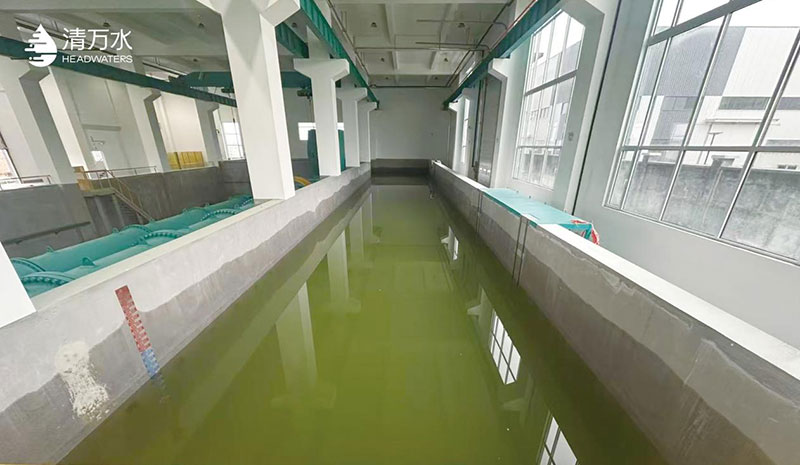
- Covering an area of over 3,000 m², the Headwaters Acoustic Three-Dimensional Monitoring Technology and Intelligent Instrument Research Laboratory incorporates top-tier design concepts featuring “large diameters, wide channels, high flow rates, low energy consumption, precise measurement and interdisciplinary collaboration”. Its test pipeline diameters range from DN1000 to DN3000, covering the vast majority of pipe-diameter specifications adopted in large-scale domestic water diversion and transfer projects. This provides an ideal “physical-examination center” for large-diameter ultrasonic flowmeters, electromagnetic flowmeters and other devices that previously could hardly undergo real-flow calibration.
- The laboratory houses a gigantic open-channel test section with a 7-meter width and 5-meter water depth. It can fully simulate real-world flow patterns such as those in forebays of large pump stations, river estuaries and wide river courses, completely eliminating “scale distortion” caused by scaled-down models. It delivers an unparalleled real-test platform for the optimized design of major water-conservancy projects.
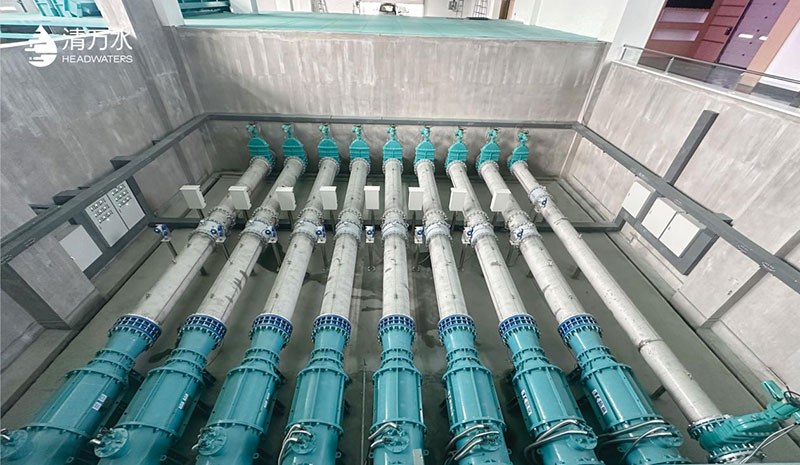
- Rejecting the conventional high-energy-consumption centrifugal-pump solution, this technical center innovatively adopts eight low-head tubular pumps. With a total installed power of merely 600 kW, it delivers a maximum flow rate of 30,000 cubic meters per hour and achieves a high flow velocity of 5 m/s within the DN1000 pipeline section.
Multiple “Firewalls” Established for Accuracy Assurance
- Dual-reference-meter verification system: On each core reference pipeline, reference meters working on ultrasonic and electromagnetic principles are installed side-by-side. Real-time data comparison and mutual cross-checking guarantee absolute reliability of the reference source.
- Original “in-situ” verification system: An independent DN500 bypass pipeline fitted with reference meters is specially deployed. This system enables “on-line inspection” of main reference meters without dismounting them for external calibration. It addresses the difficulties and excessive costs associated with sending large reference meters off-site for calibration, and ensures long-term stability and consistency of the entire metrological traceability system.
Integrated Platform for Industry-University-Research-Application-Inspection via Interdisciplinary Collaboration
Strategic linkage has been established with the Jihongtan Pump Station of Shandong Jiaodong Water Diversion Project, located seven kilometers away. Complex on-site flow phenomena (such as cavitation and vortices) can be accurately reproduced and diagnosed inside the laboratory. Meanwhile, CFD (Computational Fluid Dynamics) simulation and PIV (Particle Image Velocimetry) experiments are introduced to render invisible water flows visible and quantifiable for analysis. This elevates measurement work from merely “obtaining results” to “understanding underlying mechanisms”. Research into AI-powered full-process intelligent laboratory control is also underway, targeting the development of a “cloud laboratory”. Serving as a cross-disciplinary research platform integrating fluid mechanics, hydraulic structures, artificial intelligence, ecological environment studies and other disciplines, it supports full-chain innovation ranging from fundamental scientific research to industrial applications.